5 nov. 2011

ROLANDO VILLAZÓN CANTA "O DIEU, DE QUELLE IVRESSE", LES CONTES D'HOFFMANN 4/11/2011

foto: Herbert


Ayer, 4 de noviembre, tuvo lugar en la Bayerische Staatsoper la segunda de las funciones de Les Contes d'Hoffmann. El éxito fue igual o superior al de la noche del estreno, en el que los protagonistas quizá no estuvieron seguros al 100%. En cambio, ayer, más relajados, tanto Rolando domo Diana demostraron sin reservas su magnífico estado vocal y su altísimo nivel interpretativo.

Una incidencia hizo parar la función: en el cambio de escena entre el acto I y II, Rolando y otros estaban de pie delante del telón (cuando sale la imagen de la pipa y el humo). El telón no se abría, y cunado Rolando notó que había algún problema empezó a hacer gestos divertidos (rascarse la pierna, la espalda), silbar una melodía, mirar el reloj de manera ostensible, para entretener al público...hasta una hombre, bastante nervioso, entró en escena y le dijo algo al director. Luego se hizo un anuncio: un tramoyista se había caído en el foso de debajo del escenario, y estaban esperando a los servicios de urgencias, porque parecía que se había hecho algún daño. Después de 30 minutos, se reemprendió la función con normalidad.

Os dejo fotos de Herbert, Willeke, Anne, Marion y Eleonore, y un audio enviado por un lector anónimo, de un intenso y bellísimo "O Dieu! de quelle ivresse" del duo con Giulietta en el IV Acto. ¡Muchas gracias a todos!


Giulietta
Non! je te rejoindrai, mais pars!
Je tremble pour toi! Pars! à l'instant même!
Hoffmann
Te quitter, Giulietta! te quitter... Non!
Je t'aime! je t'aime...
Giulietta 
Malhereux! mais tu ne sais doncs pas
Qu'une heure, qu'un moment, peuven être funestes!
Que mon amour te perd à jamais, si tu restes!
Qu'avant demain l'on peut t'arracher de mes bras!
Ne repousses pas ma prière!
Ma vie est à toi toute entière!
Partout, partout! je te promets d'accompagner tes pas!
Hoffmann
Ô Dieu, de quelle ivresse embrases-tu mon âme,
Comme un concert divin ta voix m'a pénétré!
D'un feu doux et brûlant mon être est dévoré;
Tes regards dans les miens semblent verser la flamme,
Comme des astres radieux!
Et je sens, ô ma bien-aimée,
Passer ton haleine embaumée
Sur mes lèvres et sur mes yeux!
Passer ton haleine, ton haleine embaumée
Sur mes lèvres, sur mes lèvres et sur mes yeux!
Ô Dieu! de quelle ivresse embrases-tu mon âme,
Tes regards dans les miens semblent verser, semblent verser la flamme!
--
-
Añado un nuevo video que ha subido hoy a su canal de Youtube la Bayerische Staatsoper, con alguna imagen ya contenida en los anteriores, pero también con aportaciones nuevas.


FOTOS 4/11/2011

foto: Herbert

foto: Herbert

foto: Herbert

foto: Herbert

foto: Herbert
foto: Willeke

foto: Willeke

foto: Anne

foto: Anne

foto: Anne

foto: Anne

foto: Anne

foto: Anne

foto: Anne
foto: Anne
foto: Anne

Rolando abraza a Angela Brower - foto: Anne

Angela Brower, "desrolandizada" - foto: Marion

foto: Marion


foto: Eleonore

foto: Eleonore

foto: Eleonore


4 nov. 2011

Rolando Villazón: "You must build a Universe" - Interview Süddeutsche Zeitung

foto: Stephan Rumpf - Süddeutsche Zeitung


En Munich se edita el periódico alemán de más prestigio, el Süddeutsche Zeitung, similar en calidad a un New York Times en lengua alemana. Al dia siguiente de la première de Les Contes d'Hoffmann, se publicó esta interesantísima entrevista a Rolando Villazón, realizada por Egbert Tholl.
-
Hannah me puso en la pista, y Janet, desde USA, se ofreció voluntaria para traducirla al inglés, sabiendo que muchos de los lectores del blog entienden este idioma y, si no, es más accesible para quien lo tenga que traducir. El trabajo ha sido muy extenso, y agradezco muchísimo la colaboración de las dos: danke schön, thank you very much, muchísimas gracias !


http://www.sueddeutsche.de/muenchen/tenor-rolando-villazn-im-interview-man-muss-ein-universum-bauen-1.1178314


"You must build a Universe"
Interview: Egbert Tholl

The lyric tenor Rolando Villazón sings at the Bavarian State Opera the title part in “Hoffman’s Tales.” A conversation about “Werther” — and the state of his own voice.

Jacques Offenbach’s opera “Hoffmann’s Tales” has its premiere under the direction of Richard Jones at the Bavarian State Opera. The musical direction is by Constantinos Carydis. Rolando Villazón sings the title part. He last sang in Munich Nemorino in “L’elisir” and at the beginning of the year became a stage director himself with “Werther” in Lyon. In conversation (in English) Villazón acted as though there hadn’t ever been any crises. He bubbles, he sparkles, he spins, he presents you with the whole opera under high pressure. A marvelous experience, that can only be reproduced inadequately in words.

ET: At the end of our last conversation we talked about literature.

RV: Mmh.

ET: You read at least one good book a week.

RV: Mmh. But who knows what remains in my head from it.

ET: Do you know the tales of E.T.A. Hoffmann?

RV: Yes. But it is not necessary for an actor to read the book on which an opera is based. One doesn’t need to read Mérimée in order to sing “Carmen” or Dumas’ novel for “Traviata.” Nevertheless, the more one reads, the more imagination one gets in order to develop a stronger character on the stage. Therefore, I would recommend to a soprano that she reads “Anna Karenina,” “Madame Bovary,” or “Nana” if she wants to sing Violetta in “Traviata.” Regarding “Hoffmann,” naturally the opera is based on a piece by Barbier and Carré, but the stories of E.T.A. Hoffmann were used by these two. Offenbach saw the piece and wanted to put it to music.

ET: Then knowledge of the stories can enrich the character of Hoffmann?

RV: Yes, but there’s another aspect. I believe that the less information the singer brings, the better it is for a really good stage director to work with him. First I see what a director wants, and then I decide what I’ll read. In past weeks, for example, I’ve read Bulgakov’s “Master and Margarita” — you know the story of the devil who comes to Moscow — that is the same situation as in “Hoffmann” in the Giulietta act. If one arrives at the first rehearsal with a firm idea about how one wants to play a role, then one is likely to become a problem for the director.

ET: But you can’t hide that you know everything.

RV: No, no, I try to arrive completely empty.

ET: Although you’ve sung Hoffmann in four productions already?

RV: Yes, and then you forget that again. That was yesterday. Every time it’s a new piece. Because Offenbach died before he could complete the opera. Every opera house uses a little different version. Here a small chorus is added, there one is cancelled.

ET: What’s new in Munich?

RV: There’s a trio that I’ve never sung before. In the Olympia act there’s a different sequence, also in the Antonia act, there are some small pieces that are new for me.

ET: Have you sung in a production before in which all four distinct women characters are sung by the same soprano as here with Diana Damrau?

RV: No, that is absolutely unusual. Good, a very few sopranos have sung that, Gruberova or Sutherland, but I know almost no one who can do that today. Diana is amazing. She has an unbelievable instinct on the stage, it is a great joy to work with her. She is wonderful and can sing the characters so that you believe they were written for her.

ET: Does it mean something for the interpretation that Stella and the three imaginary women are sung by one woman?

RV: Offenbach wanted one singer for the four parts. Even when there are four different singers, there is usually a sense at the end that all four can be one woman. What’s wonderful about Hoffmann is that in one evening you can play four roles. You have Hoffmann in the Prologue and the Epilogue who is drunk, who struggles with writing, who asks himself if he should follow life or art, whether he should lead an anarchic or an ordinary life. And in the Epilogue you have in addition the Hoffmann who knows that his opportunity with Stella has slipped away, that now only writing remains for him. And then in the Olympia act Hoffmann can be happy and naive, not at all brooding, one can portray him as a brother of Nemorino. He’s in love with a doll! But that must also have something important to it. Something from “Alice in Wonderland,” as in the stories of E.T.A. Hoffmann themselves, these outside-of-reality stories that yet play within reality. These stories come from a nightmare, but the nightmare is a completely normal dream that actually is reality, which we must just accept. Then you feel really well in this world.
 Richard Jones is a genius. I love to work with him. He wants everything to be very serious. We shouldn’t make jokes, one should not become a caricature. You must act it so that Hoffmann is truly in love. It’s almost like Alfredo’s love for Violetta in “Traviata.” No tra-la-la.

ET: The doll Olympia is also completely real for him?

RV: The more seriously you play, the better the story is. If you only pretend, it’s all a joke. The audience should wonder, but it should accept his love for a doll.

ET: But this is also a bit comical.

RV: Yes, out of this complete seriousness comes the best comedy. It’s really a very merry act. In the Antonia act, Hoffmann becomes a serious character, his experiences have made him contemplate marriage. Then he observes that not everything is right with Antonia, that she should not sing, and finally she is dead. And he believes that he is guilty for this. In this moment, Hoffmann is a very lonely, very lost person. In the Olympia act, he needs no guidance: he lives in this world and soaks it up.

ET: During the Antonia act, he operates like an alien element that doesn’t belong here.

RV: Exactly. He wonders what the people are talking about, what secrets they have. It is not reality. He’s forced into that in the Giuletta act. Or better, he forces himself. If that’s the world, then so be it. He tries to play by the rules of the nightmare. Who understands the world in which we live? Who understands how business really works? How politics function? Which system is really the best for humanity? The metaphor here is very strong, even for our own times. It’s a wonderful opera. It’s a shame that Offenbach died before he could complete it. I picture how Offenbach worked in the night, feverishly and with despair: he wants to finish it, he wants to see the work on the stage. And then he knows, no, it won’t work, he won’t ever see it. Actually he was a happy man, a Hoffman-man.

ET: Who in his person explains life against art. Which of the four Hoffmanns is your favorite?

RV: They must all come together. You must love them all. Perhaps one can choose one for oneself, but I can’t. Within the act, there is no development of character. You must simply change the character. The development comes altogether from the man Hoffmann is in the Prologue to that which he is in the Epilogue. The three stories that we see have transformed the man of the beginning. We see this transformation. It’s not like, for example, Don José (“Carmen”). In that you see how he has changed, how he has become a killer. Here, no. But, when he sings “Kleinzack” at the end, he is completely another man. He can no longer sing as in the beginning.

ET: We meet Hoffmann again after three hours, and he is someone else.

RV: He is the same man, only three hours later. Now he has all these Hoffmanns in himself. Like when one sits together for a long time and drinks vodka. The vodka opens the inner feelings, and one starts to tell a story. About women and love. And Hoffmann tells of three women, of three loves, and knows that’s all nonsense because the three women are only one, the one that he loves. At the beginning, he talks, still full of élan: Ha, you want to hear a story, here it is! Cheers! (Villazón jumps up and rollicks around the room.) And then comes this guy who gives him glasses so that he doesn’t know that it’s a doll, and so on and so on, still a magician, Cheers! And all the listeners enjoy themselves and believe him or not, and he tells further about a woman who must not sing or she will die. And he drinks, and the listeners drink, and all are eager how it continues. And he talks and talks and drinks and drinks. And he tells that the woman sings and dies. And he howls and cries and is in despair. And then: let me tell you about a guy who was in love with a whore. Hahaha. And the woman plays with him, but he loves her. And Hoffmann who tells the Hoffmann-stories, becomes ever wilder and his listeners are enchanted, and he is completely exhausted. And then his stories are over, and the others want to hear “Kleinzack” once more, therefore he sings “Kleinzack,” until he breaks down completely drunk.

ET: Can you do that exactly the same again?

RV: (Laughs) There it is. You cannot do it as if nothing has happened. (Villazón sings with a self-consciously sweet voice to make it clear how Hoffmann at the end should not sound.) That wouldn’t work. With these stories he gives form to his suffering, makes it bigger.

ET: Would this be the description of the production if you were to stage “Hoffmann” yourself?

RV: No. As I staged “Werther,” at the beginning it was a very cold, pragmatic work. Before I began to talk of feelings and psychology, I went through the whole piece. Completely cold: you go here, you go there, you do this, you that. And I said: Don’t ask me any questions, questions come later. After six or seven days, the piece was staged, everyone knew what to do and when. Then it had to be filled with individuality. For example, I wanted Albert and Charlotte really to love each other. I don’t like it when Albert is a hard, stupid guy. Then why shouldn’t Charlotte leave him for Werther?

ET: Did the clowns in your “Werther” staging contribute this poetic commentary-level from the beginning?

RV: Yes. I thought what is “Werther” about. It is about determinism, by society and family. There is no escape from duty. From the beginning I wanted to work with colors, bright colors for the children, etc. Many things I discarded again. The determinism goes further, from the marriage until death. And the clowns embody free will, the anarchic power.

ET: The decisions are apparently quite similar. Albert and Charlotte must love each other, otherwise the story doesn’t work. As Hoffmann must love the doll Olympia. One must maintain these feelings.

RV: Yes, yes, yes. To be honest, perhaps it would work if you portray Albert as a strict man, a real ass-hole, and Charlotte perhaps as a drinker. It would also work. The important thing is only: whatever you decide, you must seriously maintain it. You must believe it yourself. You must believe in the characters. If Olympia is for Hoffmann the most beautiful woman in the world, then so it must be. Naturally, all of this is a metaphor. What does it mean if Hoffmann loves a doll? What does it mean for his real love Stella, in whom he sees the three women? What side of Stella does Hoffmann describe with Olympia, with Antonia, with Giulietta? Does Stella herself sometimes behave like a doll, a doll in the round of society? Is Stella as merciless as Antonia— I sing and die. Is she as seductive as Giulietta, who will stop him from writing? All belong together.

ET: Do you discuss such questions with your wife, who is a psychologist?

RV: Sometimes. I believe we talk more about how the production is running, which ideas are treated in it. She has a very good eye for aesthetics. When she watches, she sometimes asks me afterwards what a particular movement was supposed to express. If she asks, then it wasn’t clear. Then I must think how can I make it clear. All this talk, these many ideas — how many can one put on the stage? What I said before is also a way to clarify for myself what it’s about and what I must play.

ET: Isn’t that too bad?

RV: What?

ET: That one can’t convey all ideas on the stage.

RV: Now, what I’ve been saying up to now has perhaps more to do with writing than with acting. These thoughts are only working stuff for the performance. Richard Jones is also so good for this reason, because he cleans everything away. You can try everything, try everything once in the rehearsals. You must not do that in the performance. You have it in your head. Everything that is too much you must cut away. It must be theater, not décor. Film is always more exact. Theater on the other hand must send a theater-message. Theater has its own language. And that’s not a film-language. You must build a universe. You can hate it or love it, as with my “Werther.” But it must be built.

ET: And now: how is it going with your voice?

RV: (Laughs) I am curious for how many decades I will be hearing this question. It’s going super good.

ET: Do you now finally keep an eye on yourself? Ordinarily, it’s still so: Scarcely does it go prima with you, then again you do way too much and zack, Villazón is kaput again.

RV: I am what I am, I can only sing the way I sing. Otherwise I must contradict you. I have a lot of free time, I don’t do a thousand things at the same time.

ET: But you did do that.

RV: Yes, I did it. And I would do it again if I had to. A thousand thanks for all I was allowed to do.

ET: You would lead the life again that you did from 1999 to 2006?

RV: I would do the same things.

ET: I suspected that.

RV: That’s the point that many perhaps don’t understand. I didn’t cause my illness through my manner of singing. That would be a simple explanation, but the truth is more complicated. Do you know how many phone calls the doctor who operated on me has received? None. If anyone asked him, he would say — for he has permission to do so — that I had a genetically caused cyst that I would have had no matter how much or how little I sang.

ET: Completely independent of how much you sang?

RV: Perhaps I hastened the process, also through the manner in which I sing. But that is not certain. Who knows in any case how long he will sing — three, ten, twenty years? I don’t know that. But for as long as it goes, it will go as I want it to and as I feel it. Even if it doesn’t go well. For a year I’ve felt really good. Before the operation, I wasn’t capable of singing Don Ottavio. And finally the answer is: yes, I am always a high-wire dancer. I dance on the wire, without net and padded floor.

3 nov. 2011

"LEVARSI UN FIL DI FUMO" - LES CONTES DE... SANDRO

foto: web Bayerische Staatsoper

Sandro, Nadia e Margherita, fidelisimos villazonistas, estuvieron presentes en la première de Les Contes d'Hoffmann en Munich, y hoy contamos con el resoconto de Sandro, que complementa perfectamente la otra crónica de ayer. Al final del post, os dejo otras tres fotos de los carteles exteriores que hizo Ingrid A., además de las dos que puse ayer. Mille grazie, cari!

Come il levarsi di un fil di fumo denso e inafferrabile, così le sfortunate vicende d’amore di Hoffmann sembrano perdersi  nei recessi più remoti dei ricordi opachi e trasfigurati del protagonista. E’ il filo di fumo che esce dalla pipa di Hoffmann e che scrive nel cielo il nome delle tre donne amate dal poeta, che nascono e muoiono in un tempo di bruciante rapidità, per rinascere dalla penna del poeta avvolte dai fumi dell’alcool  che il buon Nicklausse provvede a non far mai mancare al suo padrone.
Tutto si rivede e rivive in uno spazio chiuso e claustrofobico, la cameretta di Hoffmann, che diventa il palcoscenico dove di volta in volta il protagonista proietta la rivisitazione quasi onirica e di certo trasfigurata del suo “vissuto”.  E dove l’urgenza dello scrivere, del raccontare, del rendere eterno  attraverso la poesia il proprio mondo finito, diventa ossessione.
Les Contes d’Hoffmann è opera complessa, indecifrabile in molti passaggi, difficile da raccontare, ma capace di suscitare emozioni e impressioni fortissime. Ed è molto “stuzzicante” dal punto di vista “intellettuale”.
E’ difficile raccontare e contenere in queste poche righe tutto quello che l’allestimento di questi Contes “ di Monaco, noi eravamo presenti alla premiere del 31 ottobre, hanno detto e comunicato, per la ricchezza dell’allestimento, l’affollarsi di particolari, l’assoluta grandezza degli interpreti.
Rolando è perfetto, perfetto nel ruolo. Forse grazie ad una capacità mimetica che gli consente di aderire totalmente  non solo a questo, ma a tutti i personaggi che interpreta, riuscendo a toccare tutte le corde del sentimento umano. Una sensibilità e un’intelligenza interpretativa che partono, lo si capisce, da una conoscenza profonda dell’animo umano, che lui rende attraverso il suo canto, il muoversi del suo corpo, il modo di porgere ogni parola. E poi energia, tanta! Crea quella magia del teatro che rende ogni sua recita unica ed elettrizzante. Un’immagine tra le tante, molto poetica e chapliniana, Rolando con le spalle al pubblico, le braccia allargate, i piedi leggermente divaricati, le testa un po’ inclinata, che osserva, immobile, gli avventori della taverna di Luther.
E in un ruolo, sfaccettato, caleidoscopico come questo Rolando dà il meglio di sé. A parte alcune insignificanti incertezze dovute magari anche all’emozione per una serata di quelle “Importanti” per la carriera di un’artista del suo livello, il canto risulta bello, sfumato a tratti, robusto in certi momenti e testimonia di una ritrovata, totale, forma vocale, che ci riempie il cuore di gioia.

A margine vorrei salutare tutte le amiche e gli amici Villazonisti, sia quelli presenti in sala che quelli che in sala c’erano solo col pensiero e, nella speranza che l’amico Rolando legga questa mia piccola testimonianza, cogliere l’occasione per salutarlo e ringraziarlo, anche da parte di Margherita e Nadia.

Abrazos rolanderos a todos!!!
Sandro Corti

cartel exterior - foto: Ingrid

cartel exterior - foto: Ingrid

cartel exterior - foto: Ingrid

2 nov. 2011

LES CONTES D'HOFFMANN EN LA BAYERISCHE STAATSOPER, CRÓNICA

foto cartel exterior Staatsoper: Ingrid A.

Les Contes d'Hoffmann poseen una cualidad laberíntica y estratificada: por un lado son como una muñeca matrioska, con conceptos dentro de otros, por el otro son como un puzzle de piezas que sabemos que nunca acabaran de encajar. Poseen muchos niveles de lectura e interpretación, tan cierto el superficial como el remoto. Tiene ironía, sarcasmo, hasta crueldad, desde un epidermis de opereta.
--
Y, para acabarlo de complicar, está el tema de las versiones. Yo diría que no existen la"versión Cloudens", la "versión Oeser", la "versión Kaye", etc., etc. sino que cada vez que alguien dirige unos Contes, crea su propia versión, con un poco de aquí, otro de allá, recortando o añadiendo a su gusto. En este caso, es una mezcla de la "Kaye" y la "Keck". Consta de 5 actos, en lugar de prólogo, 1º, 2º, 3º y épílogo. Estoy traduciendo el argumento (según el librito oficial) al español, para que os hagáis una idea más concreta de su desarrollo las personas que tengáis el audio o las que aún podáis ir a Munich, pero primero prefiero acabar de escribir este post, y poner la traducción más adelante.


Los estudiantes, en taberna de Luther (Nuremberg)
--
-
Se inicia el primer acto con un escenario con toda la gama de colores otoñales: verdes en varios tonos, ocres, marrones. Ciertamente, la primera imagen que vemos es a un Hoffmann otoñal, casi tendido encima de una mesa, intentando sin éxito escribir. Aquí, no se diferencia entre la Musa y Niklausse, son la misma persona todo el rato. Y Richard Jones hace un guiño de esos multi-interpretables: parece que en realidad tambien Niklausse-la Musa es el alter ego de Rolando. Los dos personajes van vestidos exactamente igual, en el primer acto uno aparece con pantalón corto y el otro largo, pero en el segundo, por ejemplo, los dos lo llevan corto. El resto es idéntico, menos un foulard en el cuello que lleva Niklausse. Angela Brower no sólo lleva una peluca que la convierte en Rolando-2...¡sino que incluso lleva unas evidentes cejas rolandianas!

En todo caso, Niklausse es aquí el alter ego de Rolando, la parte que le lleva finalmente a sobrevivir y volver al arte, después de una vida de excesos sin medida. Ver a Rolando y a Angela con el mismo vestuario me ha recordado inevitablemente al Werther de Lyon, donde Rolando, como director de escena, nos presentaba a Arturo Chacón-Cruz siempre seguido de un niño, vestido exactamente igual que él. Aquí están en una taberna de Nuremberg, y Rolando, entre efluvios alcohólicos y otros estimulantes,  promete a los estudiantes contarles la historia de sus trágicos amores.


Rolando y Angela - Hoffmann y su alter ego Niklausse - foto: Kurier

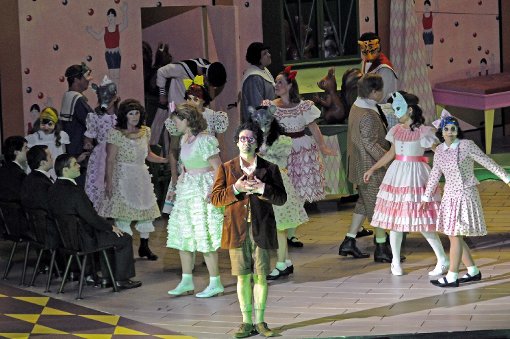
El segundo acto, el de la rubia Olympia, el primer amor que cuenta Hoffmann a sus compañeros de taberna, es claramente infantil: decorados pastel, tonos de parvulario, azules, rosas, Olympia como Cenicienta (ver imagen en post anterior). Rolando se desenvuelve a sus anchas por este acto, bailando cómicamente por el escenario. Un universo naïf, un Hoffmann al que colocan unas gruesas gafas para que vea a la muñeca Olympia como no es. El amor idealizado, ciego, falso, que, al final queda destruido.

-
-
Rolando, en pantalón corto, "de niño" - Foto: Anne Kirchbach (Abendzeitung)
Rolando valsea por el escenario

-
-
En el acto de Antonia, el tercero, oscuro, predominan los azules, malvas, colores fríos, fúnebres. Antonia va vestida con una ridícula peluca negra, y un ñoño vestido blanco: es la artista que vive sólo para su arte, no le importa nada más. Tanto, que al final muerte por él, por su imposibilidad de separar su vida de su canto. Muy buenos hallazgos en este acto, como el Dr. Miracle que surge (su cabeza) en medio de una partitura situada en el piano. Tambien la puerta con la intensa luz amarilla, que semeja una entrada a un universo poltergeist . Y el gramófono que se ilumina y empieza a sonar, con la voz de la madre, desde ultratumba. Antonia es el amor de juventud, cuya ambición (artística) trunca su futuro.


La artista y su doctor

-
El cuarto acto, el de Giulietta es directamente un prostíbulo: nada de florituras románticas, querubines y guirnaldas de flores mientras se canta la Barcarola. No, la "Nuir d'amour" es noche de sexo, y la cortesana veneciana (prostituta) aparece en la cama con un cliente, después del servicio. Él sale corriendo hacia el espejo, y ella se levanta y canta el dúo con Niklausse, que está situado casi fuera de escena, al menos fuera de la habitación. Giulietta lleva un ceñido vestido semitransparente granate, un tatuaje en el hombro (no conseguí identificar lo que era). Una larga cabellera ensortijada, de color rojizo oscuro.


El prostíbulo, el espejo


Los tonos de escena, malvas, morados, otra vez algo de verde. El amor de la decadencia, Hoffmann en el prostíbulo con juego, alcohol, sexo y muerte. El hallazgo de la escena es el espejo, redondo, inmenso, detrás del cual desaparecen los hombres para dejar una marca con su rostro, quedando ellos con una marca metálica en la cara, su lugar. El maléfico Dapertutto va recogiendo esos rostros y los almacena en unos cajitas de cristal. Es de destacar que Hoffmann no mata a Schlémil, simplemente forcejea con él encima de la cama, cae, y se clava el puñal él mismo. Giulietta muere envenenada por licor que Niklausse había rehusado beber. Hoffmann, finalmente también atraviesa el espejo, deja su rostro, sale ciego, con la cara metalizada, pero Niklausse recupera su rostro, lo recompone y lo salva.


momentos apasionados Hoffmann/Giulietta


En el quinto acto, Hoffmann y los estudiantes celebran, en alcohol, como no, el fin de las historias, concluyendo que las tres mujeres son la Stella del inicio (una cantante mozartiana). La Musa/Niklausse canta "Des cendres de ton coeur...",  y salva a un Hoffmann vencido, alcoholizado, agónico, que revive y se levanta cuando oye "On est grand par l'amour, et plus grand par les pleurs!", en sinfonia coral, ascendente y épica. Personajes de todos los actos han fomado un coro alrededor de él y, cuando la música ya ha finalizado, levantan todos a la vez el brazo, contundentemente, con un dedo acusador/señalador hacia Hoffmann.


escena final

Mi intento de condensarlo todo en unos párrafos no puede sino ser fallido, todo es mucho más complejo y denso. Debo admitir que cuando vi las primeras fotos de la producción no me pareció una estética demasiado atractiva (ojo, no digo "bonita"), pero al verla en directo la impresión cambia, y mucho. Me maravillan estas personas que creen haberse hecho una idea exacta de lo que sucedió sólo oyéndolo por radio. Una aproximación, si, un aspecto, pero se debe vivir, o al menos, ver la obra para que realmente pueda subyugarte. Digo "al menos ver", porqué, como sabéis, la emitirán por TV y saldrá un DVD.


Rolando abraza a Richard Jones, otro amante de las camisas de cuadros - foto: Bayerische Staatsoper- Facebook

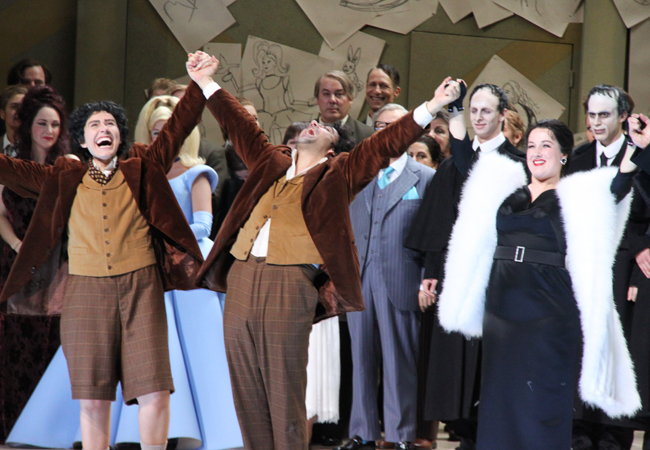
El estreno de esta magnífico trabajo de Richard Jones fue un éxito clamoroso en la Bayerische Staatsoper, bravos, gritos, aplausos, fervor del público, con tres grandes vencedores: Rolando Villazón, como Hoffmann, Diana Damrau, maravillosa, una grandísima artista, en los cuatro roles femeninos, sensual, intensa, totalmente entregada. Y el gran descubrimiento: Angela Brower, un nombre a recordar, porque canta magníficamente, es expresiva, vivaz, transmite, hace un grandísimo trabajo...y mira que es difícil hacer de alter-ego escénico de Rolando. Y mi sorpresa fue después al ver que bajo la peluca y las cejas rolandianas se escondía una guapísima rubia. Tambien es de destacar John Relyea en sus cuatro maléficos, y la orquesta, bajo la dirección de Constantinos Caridis.
--
Rolando es Hoffmann, simplemente. creo que no hay papel que le permita expandirse tanto, ser complejo, caer, levantarse, vibrar como Hoffmann. Como sucede a veces con Rolando, posiblemente no será la del estreno la noche en que haya mejor prestación vocal. En el primer acto tuvo algunos contratiempos (leves) y fue ganando seguridad en el tercero, cuarto y quinto. Sucedió lo mismo en el reciente Werther de la ROH, y a partir de la segunda-tercera función su desempeño fue ya del 100%. pero un Rolando al 90% es mucho Rolando, mucha energía, mucha intensidad, muchísima seducción, y por eso entusiasmó hasta el delirio a todos los que estuvimos presentes.

Las críticas que han salido en los medios alemanes están siendo estupendas, las podéis leer (en alemán, deberéis pasar el traductor) en la pestaña superior de "Prensa". Os pongo algunas frases destacadas:

"Rolando Villazón brilla como Hoffmann" (Dradio.de)

"Brillante en su completo riesgo vocal, largas notas altas, magníficas musicalidad y su arte único de interpretación, entre la tristeza de un payaso y el entusiasmo de un niño, con razón, causó gran entusiasmo" (Kurier)

"De Rolando destaca la tensión, pero también su energía desbordante de creatividad..." (Nuremberg Zeitung)

"Villazón se lanzó con total pasión al rol  hasta el límite del agotamiento, y convenció totalmente con un timbre cálido, su emocional elocuencia de una nivel. Su voz está (de nuevo) a su disposición" (Gissener Allgemeine)
--

foto cartel: Ingrid A.


Y AQUÍ TENÉIS LOS ENLACES PARA DESCARGAR EL AUDIO, QUE FUE EMITIDO POR BR.ONLINE  (descargas de Rapidshare, se puede escoger la versión FREE)


CINDERELLA-OLYMPIA - LES CONTES D'HOFFMANN BAYERISCHE STAATSOPER


Rubia, vestida del mismo tono de azul, zapato de salón, falda con dos volantes laterales a la altura de las caderas, cuello de escote redondo, mangas cortas levantadas, guantes de saten azul, cinta negra en el cuello y... pajarito en la mano. La Olympia de Les Contes d'Hoffmann de Munich, puesta en escena de Richard Jones y vestuario de Buki Shiff, es exactamente igual que la Cinderella/Cenicienta/Cendrillon/Cenerentola de Disney.

1 nov. 2011

TRAILERS (2) Y FOTOS LES CONTES D'HOFFMANN - BAYERISCHE STAATSOPER


Mientras voy redactando el post (que creo que no podré tener acabado hasta mañana) os pongo los videos que ha publicado la Bayerische Staatsoper (en su web y en Youtube, uno de ellos) y las fotos que me han llegado de Anne. Danke schön!

Posteriormente he añadido al final del post 7 fotos más que ha publicado en su Facebook la Bayerische Staasoper.
---------------
-------


videos: Bayerische Staatsoper


Fotos Anne


Fotos Bayerische Staatsoper- Facebook


Esta tarde, Rolando Villazón en Passion Classique, entrevista de Olivier Bellamy


Esta tarde, a las 18 (hora de Paris), el programa Passion Classique, de Radio Classique, conducido por Olivier Bellamy, ofrece una entrevista con Rolando Villazón, donde escoge algunas de sus músicas preferidas. Para quien no lo pueda escuchar en el momento, estará después a disposición el podcast.

En su página de entrada está el link para la escucha en directo.

ESCUCHAR/LISTEN/ÉCOUTER
http://www.radioclassique.fr/l-info/a-la-une/articles/article/rolando-villazon-invite-de-passion-classique-2.html

Estreno de Les Contes d'Hoffmann en Munich


Mañana mientras regrese en el avión tendré dos horas para redactar un post más detallado, que espero tener puesto mañana por la noche.

Ahora solo un post "telegráfico": unos grandes Contes d'Hoffmann, con un elenco extraordinario en su totalidad, una puesta en escena muy interesante, y un protagonista, Rolando Villazón, que es Hoffmann en estado puro. ¡Una delicia!